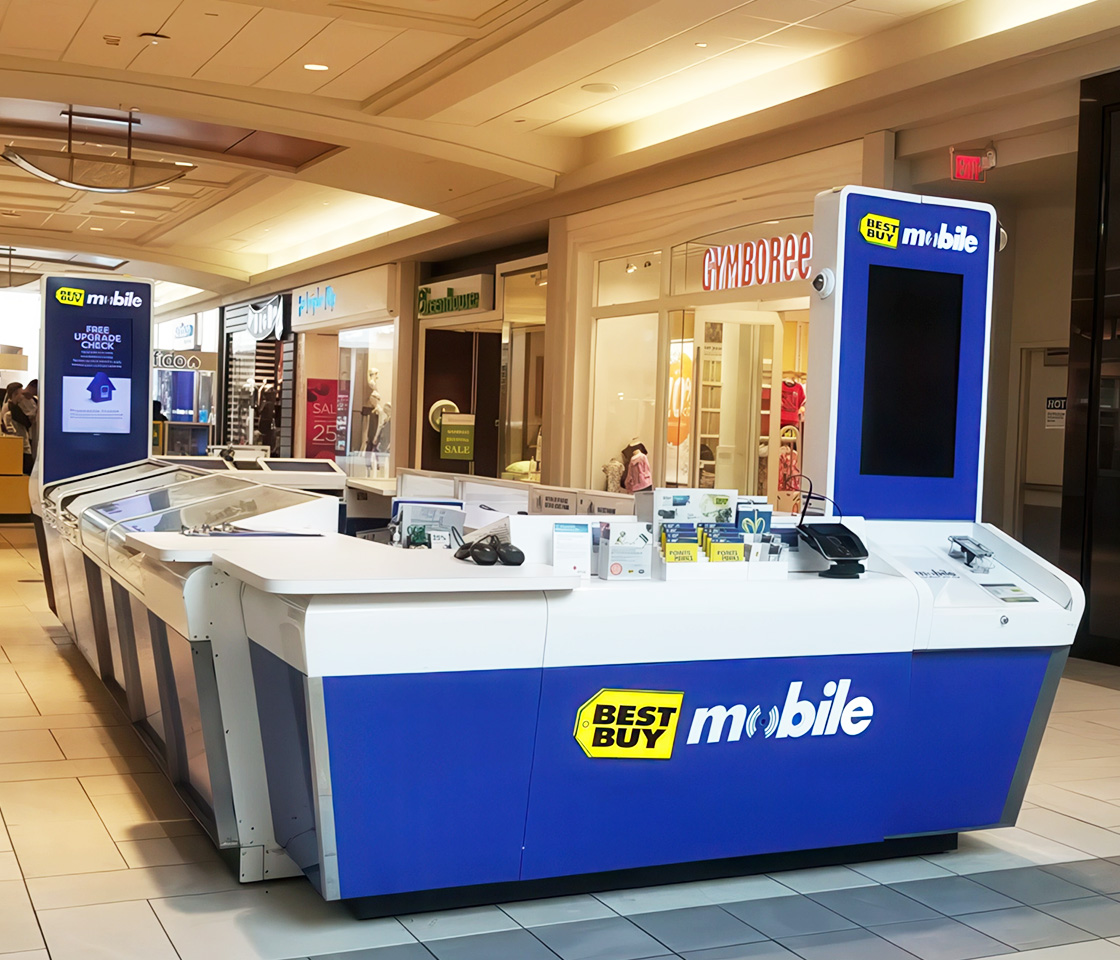
Why small retail footprints require precise planning, engineering, and execution
Mall kiosks look simple enough. Build a small counter, add a bit of signage, maybe a digital display or two? And suddenly your brand has a retail presence in the middle of a busy walkway.
But in high-traffic environments like malls, airports, and transit hubs, kiosks operate under one of the toughest constraints in retail design: what many designers call the 3-second rule.
That’s often all the time and attention the average passer-by gives a kiosk.
In those few seconds, the kiosk must communicate what it sells, why it matters, and how a shopper should engage with it — all while drawing people in from every direction.
Because unlike traditional retail storefronts, kiosks sit on open pads, exposed to constant traffic and judged from every angle.
Designing one successfully requires far more than picking attractive finishes.
Here are five key decisions that determine whether a kiosk can capture attention within those first three seconds.
 1. Concept Clarity: Can shoppers understand it in 3 seconds?
Before layout or materials are considered, the kiosk needs a clear concept.
Whether that concept is developed by an in-house retail team, an architectural firm, or a retail fixture design partner, the goal is the same: define exactly what the kiosk is meant to communicate.
Through product curation, visual hierarchy, and merchandising layout, retailers must instantly communicate three things:
- What does this kiosk sell?
- Why should someone stop?
- Where should customers stand or interact?
Because kiosks sit in high-traffic corridors, they’re rarely destination shops. More often, they’re attempting to capture attention from people already on their way somewhere else.
The most effective kiosks rely on a tightly curated product range, clear signage, and bold visual hierarchy to communicate their purpose from several metres away.

2. Footprint & Customer Flow: How shoppers approach the kiosk
They must work from multiple directions at once, often surrounded by shoppers moving through the mall or airport.
That means designers have to carefully plan how customers naturally approach and interact with the space.
Key questions include:
- Which sides are open for selling (one, two, three, or all four sides)?
- Where the primary “grab” zones should live?
- Where the point-of-sale should sit?
- How to invite shoppers in without blocking foot traffic?
The goal is simple: shoppers should feel comfortable approaching the kiosk without creating congestion in the walkway.
When the layout isn’t carefully planned, even a great concept can feel crowded, confusing, or awkward to approach.

3. Engineering the 360° Environment
They’re 360-degree retail environments that must integrate structure, power, lighting, and technology inside a compact footprint.
Unlike traditional stores, there’s nowhere to hide the mechanics. Everything — from displays to wiring — has to be carefully planned inside the kiosk itself.
That means engineering decisions often include:
- Structural support for counters, shelving, and display elements
- Electrical routing for lighting, payment systems, and digital screens
- Hidden wiring, access panels, and service points
- Durable materials that can withstand constant customer interaction
Because kiosks are exposed to constant contact from shoppers, surfaces get touched, displays get leaned on, and fixtures take far more wear than many traditional retail environments.

4. Manufacturing: Multiple materials working as one system
Most modern kiosks aren’t built from a single material.
They combine several fabrication disciplines, all working together as one integrated structure:
- Metal framing and structural components
- Millwork cabinetry and counters
- Glass and acrylic display cases
- Manufactured stone countertops
- Integrated signage, lighting, and digital elements
Each component may be fabricated differently, but they must ultimately fit together seamlessly — visually, structurally, and during installation.
That means coordinating finishes, tolerances, electrical integration, and assembly methods so every part aligns exactly as intended.
And because kiosks operate in public retail environments, those materials must also meet strict mall or airport requirements for durability, fire ratings, and safety compliance.
This is often where the difference between design intent and buildable reality becomes clear.
What looks simple in a rendering is actually the result of multiple fabrication systems working together behind the scenes.
 5. Installation Logistics: Working from coast to coast
Regardless of where a kiosk is installed in Canada, it ultimately has to arrive on site, install efficiently, and open for business on time and on budget.
And mall installations rarely happen under ideal conditions.
Most projects involve tightly controlled conditions such as:
- Overnight installation windows
- Security escorts inside the mall or airports
- Pre-booked lifts or access equipment
- Strict landlord guidelines for safety and finishes
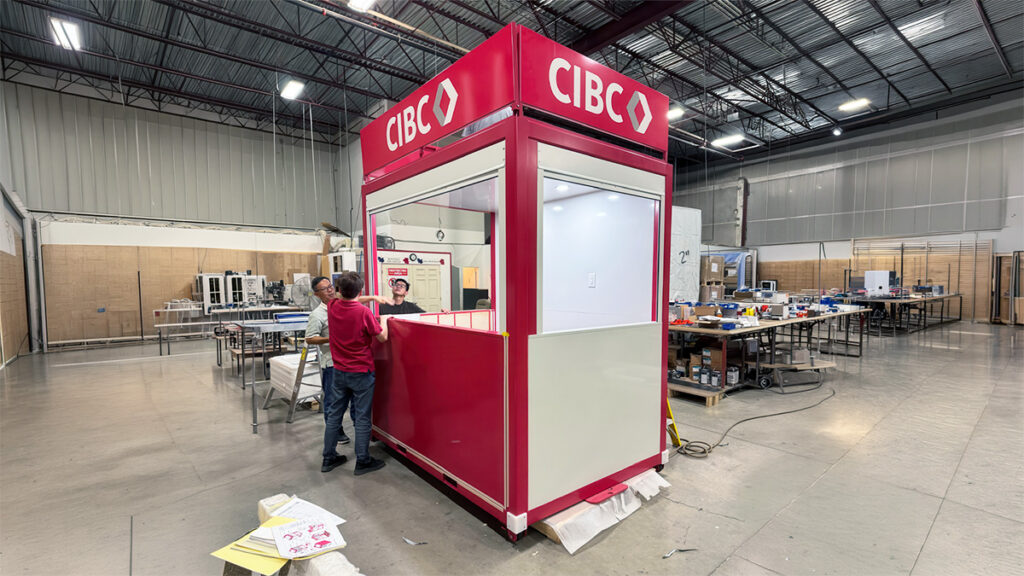
In some cases, install teams will build temporary drywall enclosures around the construction zone, allowing work to continue during business hours while maintaining safety for shoppers and nearby retailers.
Because kiosks sit in active public circulation zones, installation must be fast, controlled, and predictable to avoid disrupting mall operations.
Which is why experienced teams plan for installation long before the kiosk ever leaves the shop floor.
If the build can’t install cleanly, the concept doesn’t hold up in the real world.

The Bottom Line: Small footprint. Big job.
Mall kiosks may look simple—but they compress concept, engineering, fabrication, and installation logistics into a remarkably small retail footprint.
And when shoppers only give you three seconds to decide whether to stop, every design and build decision becomes amplified.
That’s why successful kiosk programs are rarely accidental.
They’re carefully designed systems that balance brand experience, structural engineering, durable materials, and real-world retail operations.
If you’re planning a new kiosk, refreshing an existing program, or rolling out locations across multiple malls, working with the right design and fabrication partner can make all the difference.
Contact Canada’s Best Store Fixtures to discuss your next kiosk project or request a project estimate.
Video Transcription
3 seconds.
That’s all a mall kiosk gets to stop people from walking on by.
And even though layouts look simple, they’re not.
Because retailers don’t get a storefront. They get a pad.
Exposed from every direction and judged from every angle.
Which means shoppers must understand, almost instantly:
What they sell.
Why it matters.
And how to approach the kiosk.
Here are three retailers who got it right.
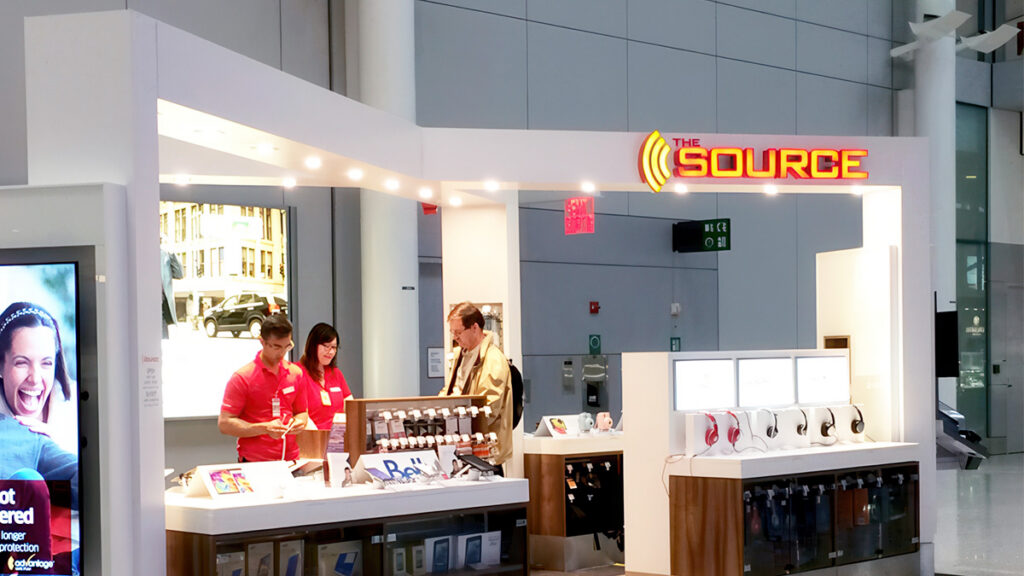
The Source’s kiosks used post-and-beam bulkheads to integrate lighting, signage, and digital displays to feature high-value electronics and make entry points unmistakable.
Blue Bottle Coffee’s first kiosk in California has a minimalist design and was prefabricated from stainless steel.
And Dolce & Gabbana’s fragrance kiosk in Florida builds on its 2024 pop-up shop Mediterranean look.
These examples show why kiosk design is deceptively complex.
Because earning those three seconds requires clarity, visibility, and intention from every angle.
That’s why our Toronto-based team designs and builds kiosks engineered to capture attention and turn it into engagement.
Kiosk design is just one of the 2026 retail trends reshaping brick-and-mortar.
You can see the full breakdown and more insights at canadasbeststorefixtures.com.
Canada’s Best Store Fixtures. We bring retail strategies to life.
***
Research and initial drafting for this article were supported by AI tools, including Perplexity and ChatGPT. All sources were independently verified, and the final content was reviewed and edited by our team.